How to Choose the Right 12v 12ah Battery for Your Needs?
Choosing the right battery for your needs can be a daunting task. According to battery expert John Smith, “A 12v 12ah Battery must match your energy requirements precisely.” This highlights the importance of making an informed choice.
Understanding how to select a 12v 12ah Battery starts with knowing your application. Different devices have varying power demands. Whether for solar power systems or recreational vehicles, the right battery ensures optimal performance. Quality matters. Don’t just pick any brand off the shelf.
Yet, even with knowledge, mistakes can occur. Many users overlook the required battery lifespan or the environmental conditions affecting performance. Reflecting on these factors can save you from future headaches. A thoughtful approach will guide you toward the most suitable choice for your specific needs.
Understanding the Basics of 12V 12Ah Battery Specifications
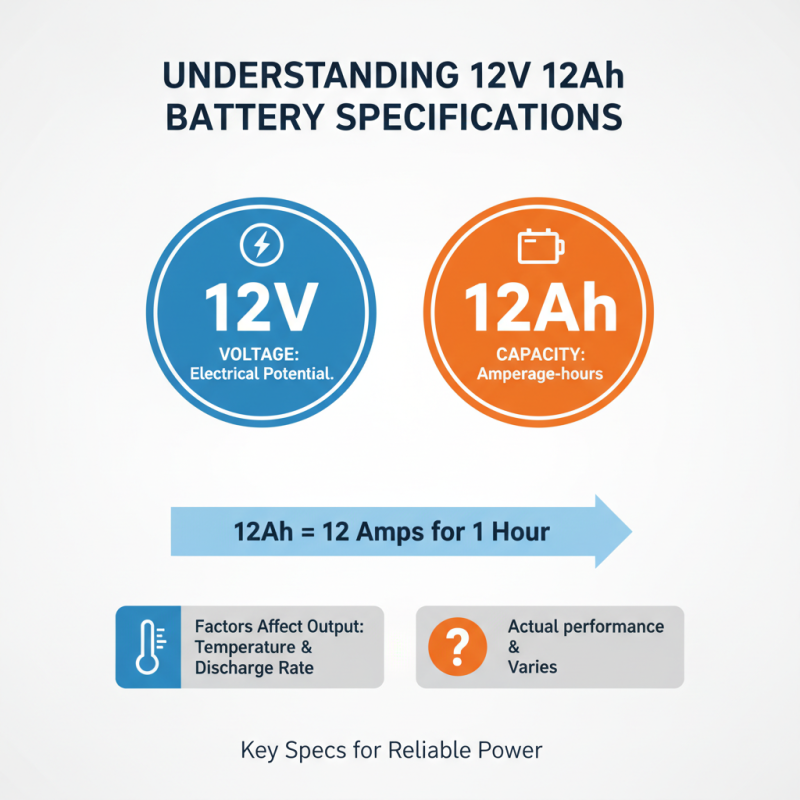
When selecting a 12V 12Ah battery, understanding key specifications is crucial. The "12V" indicates the voltage of the battery, while "12Ah" refers to its capacity. This means the battery can deliver a steady current of 12 amps for one hour. You might find variations in performance based on factors like temperature and discharge rates. These factors influence the actual output, which can sometimes lead to misconceptions about capacity.
Pay attention to the type of battery technology. Lead-acid, lithium-ion, and gel batteries are common options. Each type has unique characteristics. For example, lead-acid batteries are generally heavier but more economical. In contrast, lithium-ion batteries tend to last longer and charge faster, though they can be costlier. This truth might lead you to question your specific needs when choosing a battery type.
Another aspect to consider is the discharge rate. A battery used for emergency lights may require different specifications than one for a mobility scooter. Inconsistent power requirements can lead to performance issues. It’s important to evaluate these scenarios. Reflecting on your application is a wise step to take. Knowing these details can lead to a more informed decision.
Identifying Your Power Requirements and Usage Scenarios
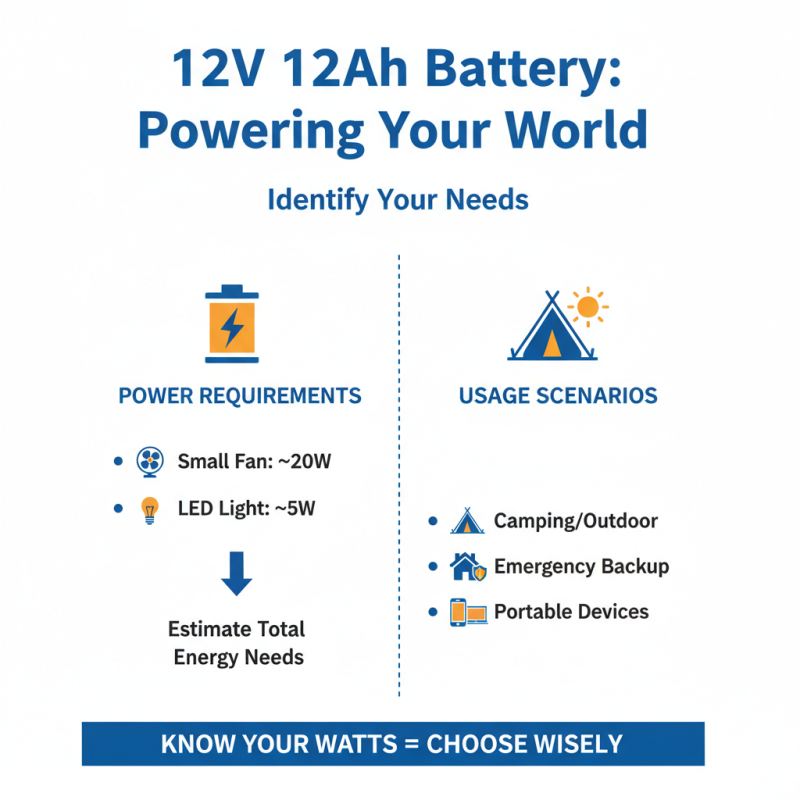
When selecting a 12V 12Ah battery, understanding your power requirements is crucial. Begin by assessing your devices. Different appliances consume varying amounts of power. For example, a small portable fan may use around 20 watts, while an LED light might only use 5 watts. Knowing these figures helps in estimating the total energy needs.
Consider how long you'll need the power. Let’s say you need to run a fan for 8 hours. With the fan's power consumption of 20 watts, you'll require 160 watt-hours (Wh). A 12V battery with a capacity of 12Ah can provide about 144Wh. This highlights potential shortfalls in your power needs, emphasizing why accurate calculations are vital.
*Tip: Double-check the discharge rates and efficiency of potential batteries. Not all batteries deliver their full capacity due to various factors.*
Different usage scenarios can complicate your selection. If using the battery for solar applications, you may also prioritize depth of discharge (DoD). A battery's lifespan often decreases with a deeper discharge, making it essential to match usage patterns. Understanding these nuances helps make informed decisions.
*Tip: Consider a battery monitor. This device can provide real-time feedback on power consumption and battery health.*
Comparing Different Types of 12V 12Ah Batteries Available
When comparing different types of 12V 12Ah batteries, it's essential to understand their unique characteristics. The two most common types are lead-acid and lithium-ion batteries.
Lead-acid batteries are economical and widely available. However, they are heavier and have a shorter lifespan. According to a 2022 industry report, lead-acid batteries typically last 3-5 years, while lithium-ion options can last up to 10 years.
Lithium-ion batteries offer advantages in energy density and weight. They are significantly lighter, making them ideal for portable applications. A study by the Battery Research Institute noted that lithium-ion batteries can charge faster and deliver consistent performance even in extreme temperatures.
However, they come at a higher initial cost. Some users may find this price point challenging, especially when budget constraints are significant.
Gel and AGM (Absorbed Glass Mat) batteries are also options. Gel batteries provide good deep-cycle capabilities but can be sensitive to overcharging. AGM batteries, on the other hand, offer better discharge rates and are maintenance-free. While both options are reliable, choosing between them requires careful consideration of your specific application.
It's essential to weigh the pros and cons carefully before making a decision.
Assessing Battery Life, Cycle Durability, and Efficiency
Choosing the right 12V 12Ah battery involves understanding critical factors like battery life, cycle durability, and efficiency. Battery life is often measured in amp-hours (Ah), which indicates how long a battery can provide energy. A 12Ah battery will deliver 12 amps for one hour or two amps for six hours. This metric is crucial for applications requiring prolonged energy supply.
Cycle durability refers to how many charge and discharge cycles a battery can endure before its capacity significantly drops. Research indicates that lithium-ion batteries often exceed 2,000 cycles, while lead-acid types might only offer around 500. Choosing a battery with higher cycle durability ensures longer usage without frequent replacements.
Efficiency is another key element. A battery's efficiency affects how much of the stored energy can be used. High-quality batteries typically have an energy efficiency exceeding 80%. Lower efficiency means wasted energy and reduced battery life.
Tip: For critical applications, consider investing in a battery management system (BMS) to monitor performance. This can help optimize battery life and prevent deep discharges.
Tip: Always check the manufacturer’s specifications and reviews. Validate claims about cycle life and efficiency through reliable sources. This can save money and headaches later on.
Despite these tips, battery performance can be inconsistent under varying conditions. Environmental factors and usage patterns play significant roles. Hence, regular monitoring of battery health is recommended for optimal operation.
How to Choose the Right 12v 12ah Battery for Your Needs? - Assessing Battery Life, Cycle Durability, and Efficiency
| Parameter |
Value |
Description |
| Nominal Voltage |
12V |
Standard voltage for lead-acid batteries. |
| Capacity |
12Ah |
Indicates the amount of energy stored in the battery. |
| Cycle Life |
500-800 cycles |
Number of complete discharge/recharge cycles before capacity drops below 80%. |
| Efficiency |
80-90% |
Percentage of energy used efficiently during discharge and recharge. |
| Weight |
Approx. 3.5 kg |
Weight of the battery which affects portability. |
| Temperature Range |
-20°C to 50°C |
Operating temperature range suitable for optimal performance. |
| Maintenance |
Low Maintenance |
Sealed lead-acid batteries require minimal upkeep. |
Evaluating Price, Warranty, and Brand Reputation in Your Choice
Choosing the right 12v 12ah battery involves careful consideration of three critical factors:
price,
warranty, and
brand reputation.
Price is often the first aspect consumers look at. However, opting for a cheaper battery
may reduce quality. It’s essential to balance cost with reliability. A battery that fails
prematurely leads to additional expenses.
Warranty length shows manufacturer confidence. A longer
warranty often means better durability. Look for warranties of at least one year.
Some brands offer even longer coverage. This can be a telltale sign of a reliable product.
Don't overlook customer support options as well. Brands that provide easy access to assistance
can save you time and stress.
Consider brand reputation carefully. Research past customer experiences. Reviews can
highlight common issues or benefits. Some companies have established themselves in the market
through consistency. Others may not have a proven track record.
Tip: Check independent review sites for authentic feedback. Authentic reviews provide
insight beyond marketing hype.
Tip: Don’t rush your decision. Take your time to evaluate different options. A hasty
choice may lead to regret.










 Tina - International Sales Director